DivNet · ACM MobiSys 2026

One malicious recording shouldn't fool every voice assistant.

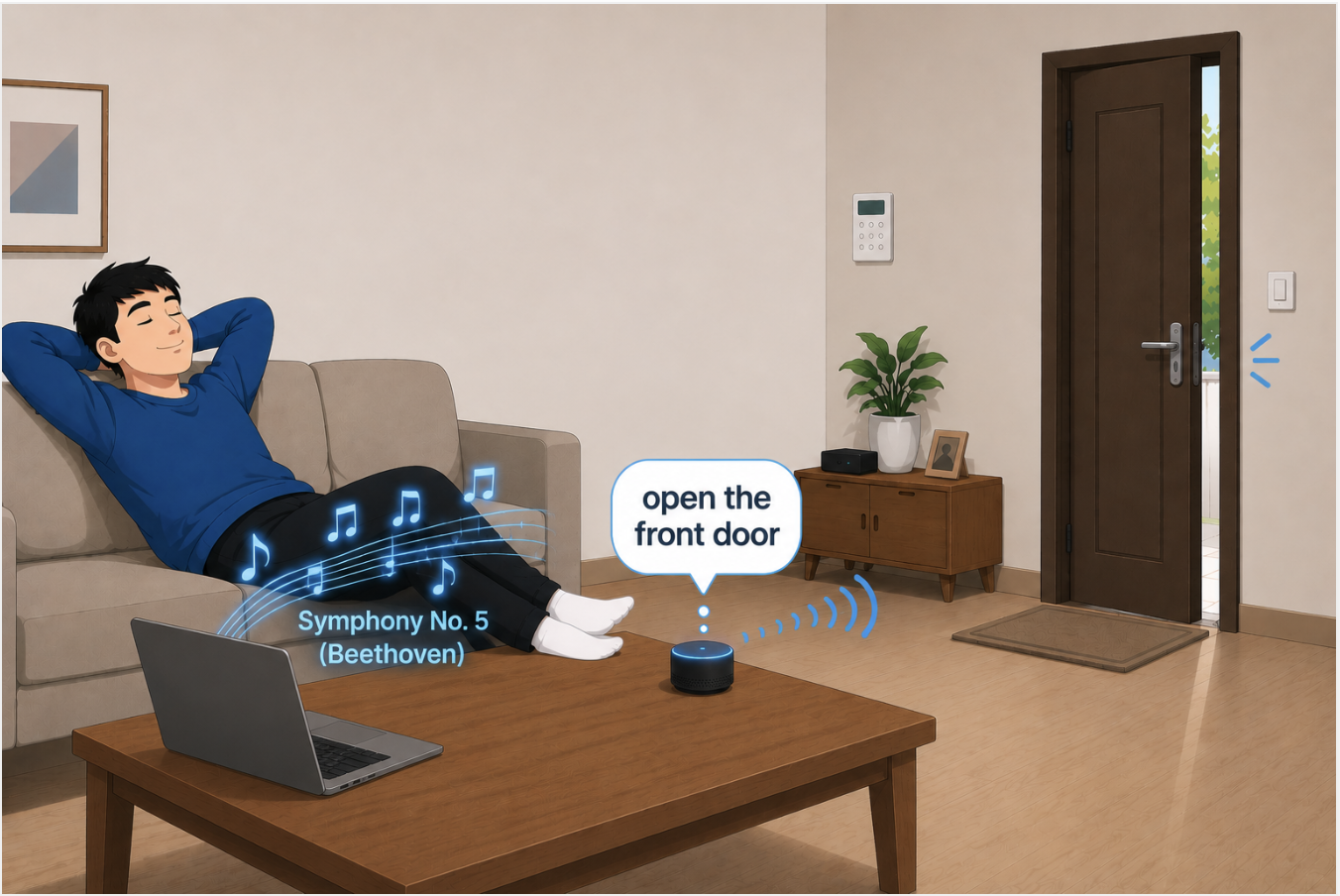
Imagine streaming your favorite music on YouTube Music. To you, it sounds like an ordinary song. But a nearby smart-home assistant hears something very different: "Open the front door." An attacker has hidden a malicious command in the audio, without making it obvious to human listeners.

By subtly manipulating audio, attackers can trick speech AI into recognizing commands that people never intended. And when millions of devices use the same AI model, an attacker may be able to craft one malicious recording and reuse it against countless devices.

DivNet breaks this "craft once, attack all" pattern. It turns one speech AI into an enormous family of different, independently protected variants.

One recording. Different interpretations.
What a person hears Ordinary music playing
What a vulnerable AI might hear "Open the front door."
What DivNet aims to do Stop the attack from working.
Illustrative scenario. Our experiments evaluated research speech recognition models, not commercial Alexa devices.
The threat

When a harmless sound becomes a dangerous command.

Attackers can fool voice assistants in two different ways. In the first, an ordinary sentence like "How are you?" still sounds normal to you, but the AI hears a completely different command, such as "Open the door." In the second, attackers disguise a voice command so that people can no longer understand it. It may sound like noise or garbled speech, yet the AI still recognizes the hidden command. Listen to the examples below and see how DivNet prevents these attacks while continuing to recognize normal speech.

Illustration of a hidden audio command targeting a smart home

A song that opens your door?

Imagine music playing from a nearby speaker. You hear an ordinary song. But hidden inside the sound is a command that a vulnerable voice assistant interprets as "open the front door."

In a system that permits such actions, the attacker could potentially trigger a sensitive operation without the listener realizing what happened.
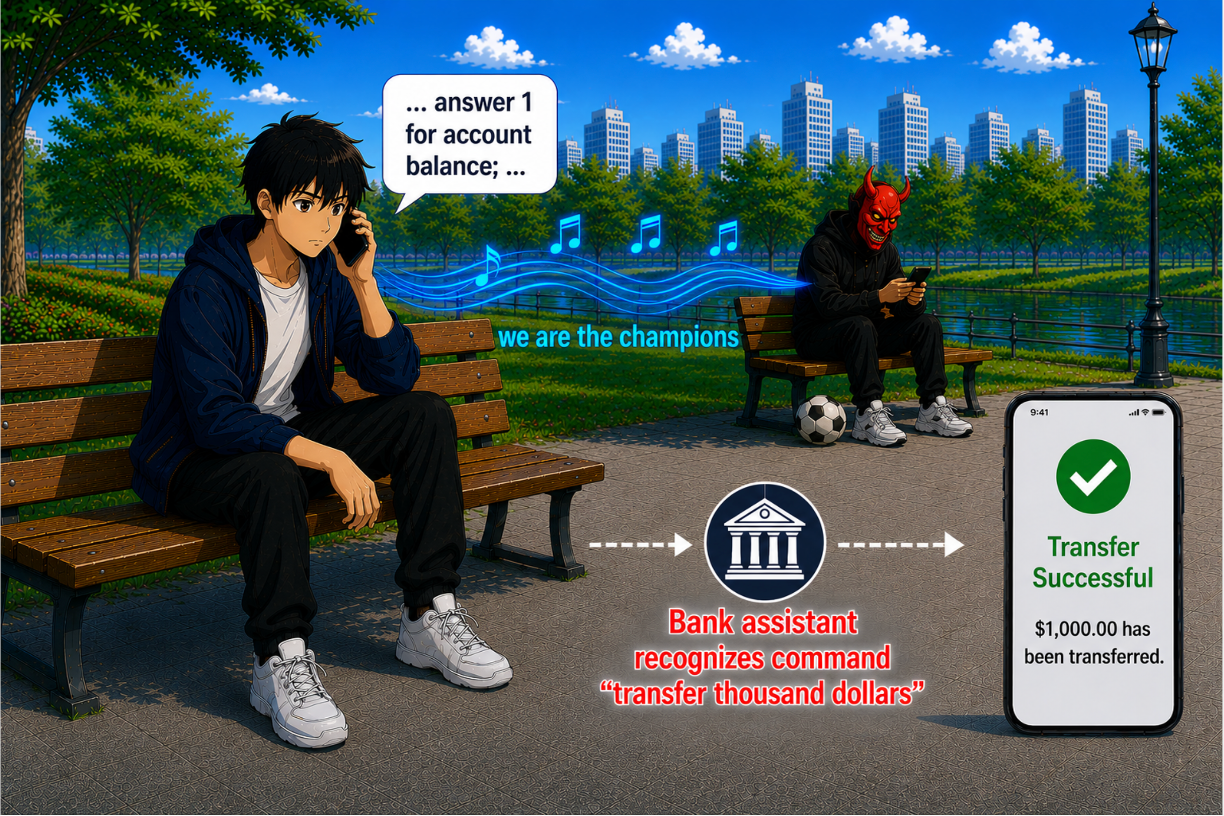
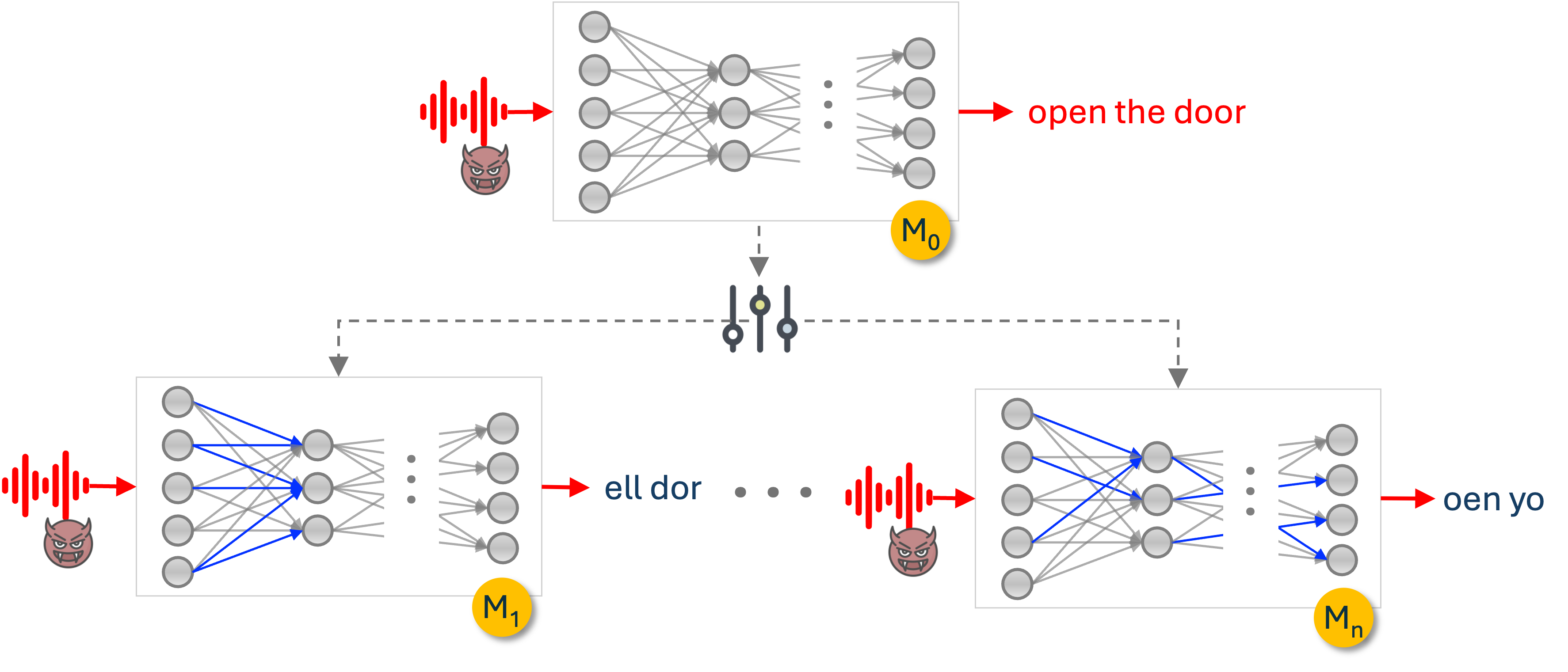
Illustration of malicious audio targeting a voice-controlled banking assistant

What if an AI heard a money-transfer command?

Picture someone using a voice-controlled banking service. An attacker plays a manipulated sound nearby. Although it does not sound like a money-transfer request to the person, the AI interprets it as one.

This scenario illustrates why speech recognition errors can matter beyond convenience, especially when AI controls sensitive actions.

These illustrations describe potential attack scenarios. They are not claims that our research compromised a commercial smart-home or banking product.

The bigger problem

One successful attack. Millions of possible targets.

Modern AI models are often copied and deployed across many devices. The copies may use exactly the same internal settings.

That makes attacks easier to reuse. Once an attacker finds a recording that fools one copy, the same recording may work against many other copies.

Imagine millions of homes sharing the same lock.

If every door uses the same lock, someone who finds a working key can potentially open many doors.

DivNet takes a different approach: give each AI its own "lock."

A key made for one is unlikely to work on another.

That is the idea behind AI diversification.

Our solution

One AI model. Countless different locks.

DivNet does not need to build or train an entirely new AI from scratch for every device. Instead, it makes carefully selected changes inside an existing speech recognition model. The resulting variants continue to understand everyday speech while responding differently to maliciously manipulated audio.

01 — FIND

Find the weak spots.

DivNet studies which internal connections matter most to an attack but matter relatively little for recognizing normal speech.

02 — CHANGE

Make small, targeted changes.

Instead of randomly damaging the model, DivNet carefully changes selected connections to interfere with attacks while retaining everyday speech recognition.

03 — DIVERSIFY

Give devices different variants.

Each installation can receive a different AI variant. An attack prepared for one variant is unlikely to work on another.

And the AI can keep changing. Because new variants are cheap to create, a device could periodically switch between variants, making it harder for attackers to rely on a single successful recording. This is a potential deployment strategy, not a claim that consumer products already use DivNet.
What we found

Enormous variety. Tiny updates. No added recognition time.

We tested DivNet using two widely studied speech AI systems, Wav2Vec2 and DeepSpeech, along with multiple types of audio attacks, including attacks designed to work across models and recordings played through speakers.

99.6%

Attack reuse failed

In a Wav2Vec2 test using CW-L2 adversarial recordings, an average of approximately 99.6% of attacks successful against the original model failed against DivNet variants. See Table 3.

6.7 ms

To create a new variant

Average DeepSpeech variant generation time, after the required one-time offline analysis. See Section 6.6.

115 KB

Average update size

A compact update can describe the changes needed for a new DeepSpeech variant without downloading an entirely new model.

0 ms

Extra recognition delay

DivNet does not add extra processing steps during speech recognition. Variant creation and updating are separate operations.

More variants than atoms in the observable universe.

"Trillions" vastly understates the possibilities. Even when we require variants to differ substantially, our mathematical analysis reveals an extraordinary scale:

Number of possible DivNet variants > Number of atoms in the observable universe

This is a theoretical lower bound on the number of distinct configurations, not the number of variants we physically generated or deployed.

Hear it yourself

Same recording. Different AI interpretations.

Listen to the audio, then compare what the original speech AI recognized with what two DivNet variants recognized. For normal speech, the variants generally agree. For manipulated audio, the original model may output the attacker's chosen phrase, while the diversified variants avoid that result.

Listen What you hear Original voice assistant hears Our variant 1 hears Our variant 2 hears

What people hear: For ordinary speech, we show the words spoken in the recording. For hidden voice commands, we describe how the audio sounds to a listener, since the words may be impossible to understand. These are illustrative listening descriptions, not results from a formal human listening study.

What DivNet does: DivNet prevents the AI from recognizing the attacker's intended command. Its variants do not necessarily recover every original word perfectly.

The research

Learn more about DivNet.

Ying Meng and Qiang Zeng. "Diversified Neural Networks: Defeating Attack Reuse via Numerous Orthogonal Variants." The 24th Annual International Conference on Mobile Systems, Applications and Services (ACM MobiSys 2026).

ACM MobiSys 2026 · Cambridge, UK · June 21–25, 2026

Overview of how DivNet generates numerous diversified neural network variants
DivNet makes small, carefully chosen changes inside a speech AI, creating numerous variants that still understand normal speech but respond differently to malicious recordings. This makes attacks much harder to reuse across variants, without compromising their ability to recognize everyday speech.